Progesterone Cream for Weight Loss: 4 Sites That Work
Where to Apply Progesterone Cream for Weight Loss & Hormonal Balance
By Asmae | Women’s Wellness Writer & Hormonal Health Specialist at WellnessSparkles.com
⚠️ This article is for informational purposes only and does not replace professional medical advice. If you are experiencing severe hormonal symptoms, please consult a qualified healthcare provider.
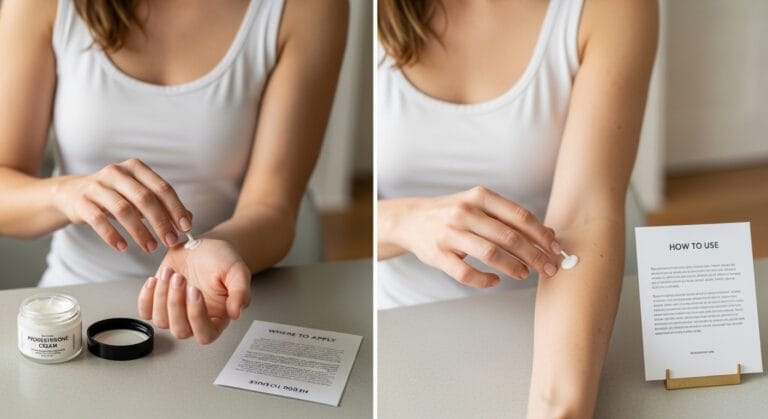
Apply progesterone cream to thin-skinned areas with superficial capillary beds — specifically the inner wrists, inner arms, behind the knees, and the upper chest or neck — where the hormone absorbs directly into systemic circulation. Where you apply the cream determines whether the therapy works or fails entirely; applying it to fatty tissue traps the hormone locally and blocks it from reaching your bloodstream. Use the application site guide and rotation table below to get this right the first time.
Quick Facts — Progesterone Cream & Weight Loss (2026)
| Women Affected | Diagnosis Delay | Time to First Results | Full Metabolic Results |
|---|---|---|---|
| 66% have never tested hormones | Over 50% wait 6+ months for diagnosis | 2–3 weeks (bloating, sleep) | 8–24 weeks of consistent use |
Why does applying progesterone cream to the wrong spot stop it from working?
Progesterone is a highly lipophilic — fat-soluble — steroid molecule. When you apply it to areas with thick subcutaneous fat, the hormone becomes sequestered inside the lipid droplets of local adipocytes, trapping it and blocking it from entering systemic circulation entirely. The cream appears to absorb, but the hormone never reaches your bloodstream or its target receptor sites.
This is the number one reason women report that progesterone cream “doesn’t work.” They are applying it to the wrong anatomical sites — the thighs, buttocks, or belly — which feels logical because those are the areas they want to address. But the physiology works the opposite way. Fatty tissue is a biochemical sponge for lipophilic hormones. Every milligram absorbed into a fat cell is a milligram that never enters your capillaries, never corrects your estrogen-to-progesterone ratio, and never triggers the metabolic, diuretic, and thyroid-boosting mechanisms that produce actual weight loss.
The clinical goal of transdermal delivery is to bypass the skin’s deeper fat layers entirely and deposit the hormone directly into the superficial capillary bed that runs just below thin skin. From there, progesterone binds to red blood cell membranes and travels systemically to every target tissue — the liver, the uterus, the thyroid, the brain.

Where exactly should you apply progesterone cream for weight loss?
The four optimal application sites are the inner wrists, inner forearms, behind the knees, and the upper chest or neck — all areas where skin is thin, capillary beds are superficial, and subcutaneous fat is minimal, allowing maximum systemic hormone absorption.
These are not arbitrary locations. Each site is selected based on pharmacokinetic data showing that thin skin produces dramatically higher capillary blood concentrations and salivary levels — up to 100-fold and 10-fold greater respectively — compared to what a venous blood test registers. This matters for understanding your results and avoiding the dangerous error of thinking the cream isn’t absorbing when it absolutely is.
Here is a precise breakdown of each site and why it works:
| Application Site | Why It Works | Best Time to Use |
|---|---|---|
| Inner wrists | Extremely thin skin, dense capillary network, minimal subcutaneous fat | Morning dose |
| Inner forearms | Large surface area, thin skin, easy to rotate with wrists | Morning or evening |
| Behind the knees | One of the thinnest skin layers on the body, highly vascular | Evening dose |
| Upper chest / neck | Excellent absorption, close to systemic circulation | Bedtime — promotes sleep via allopregnanolone conversion |
| Inner ankles | Thin skin, useful rotation site | Alternate with other sites |
Sites to always avoid: outer thighs, buttocks, lower abdomen, and upper arms. These areas have significant subcutaneous fat that sequesters the hormone and renders the therapy metabolically useless for systemic weight loss.
How does progesterone cream actually cause weight loss?
Progesterone triggers weight loss through three simultaneous mechanisms: it acts as a natural diuretic by blocking aldosterone at kidney receptors, it restores basal metabolic rate by downregulating Thyroid Binding Globulin so thyroid hormones become active again, and it reduces systemic inflammation to restore leptin sensitivity so your brain correctly registers fullness.
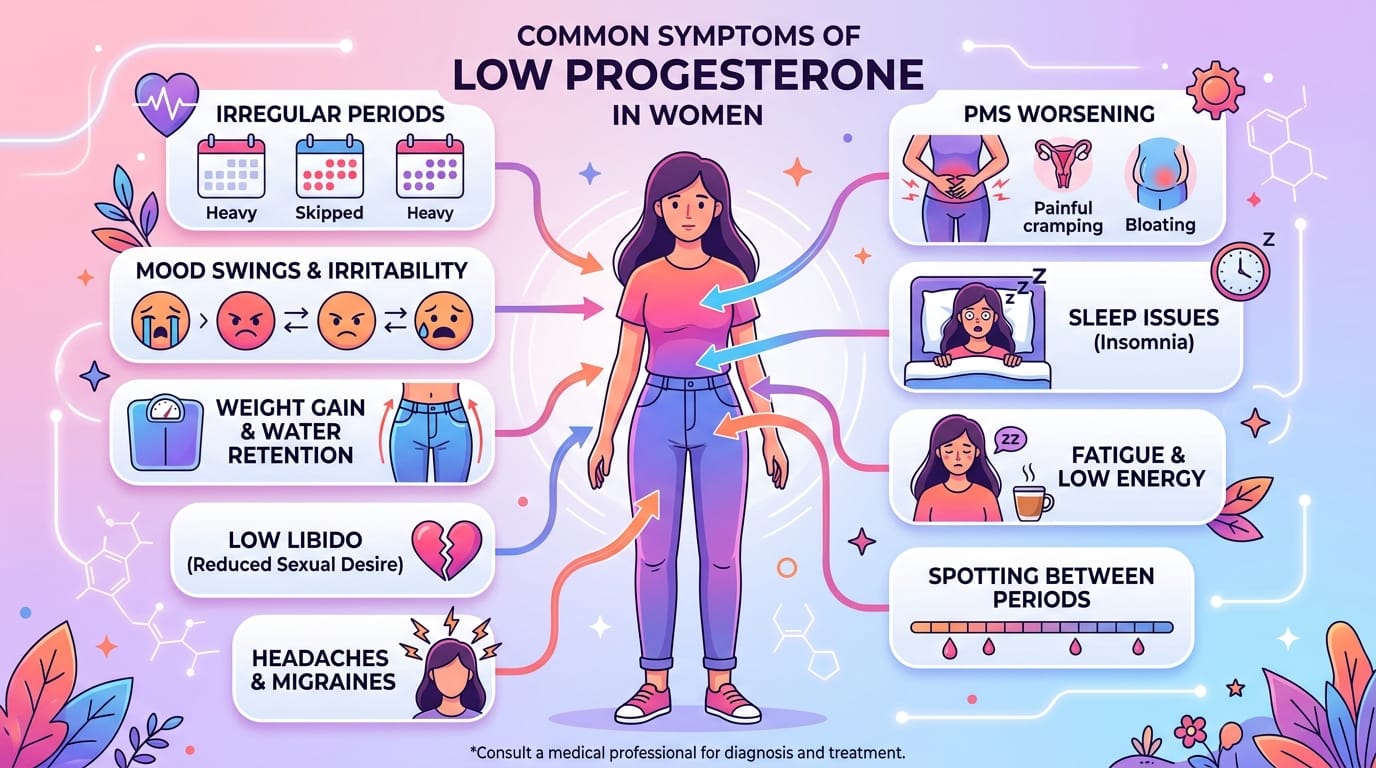
Most women experience estrogen dominance — a state where progesterone falls too low relative to estrogen — which drives treatment-resistant weight gain through mechanisms your doctor likely never explained. Here is what is actually happening in your body:
Mechanism 1 — The Thyroid Connection: Unopposed estrogen causes your liver to overproduce Thyroid Binding Globulin (TBG). TBG binds to your active thyroid hormones (T3 and T4) in the bloodstream and renders them bio-inactive. Your TSH blood test looks completely normal — your thyroid is producing the right amount of hormone — but none of it is reaching your cells. The result is functional hypothyroidism: weight gain, brain fog, and fatigue that levothyroxine prescription will never fix, because the thyroid is not the problem. Progesterone directly downregulates TBG production and frees your thyroid hormones to restore metabolic velocity.
Mechanism 2 — The Diuretic Effect: Estrogen dominance upregulates aldosterone, a hormone that forces your kidneys to retain sodium and water. This produces the bloating, puffiness, and inexplicable 3–5 pound fluctuations many women experience throughout the month. Progesterone is a competitive antagonist at the mineralocorticoid receptors in the kidneys — meaning it directly blocks aldosterone and triggers the excretion of excess extracellular fluid. This is why many women notice a visible reduction in bloating within two to three weeks of correct transdermal use.
Mechanism 3 — Leptin Restoration: Estrogen dominance drives chronic systemic inflammation. That inflammation dampens your hypothalamus’s sensitivity to leptin, the satiety hormone that tells your brain you are full. Progesterone’s anti-inflammatory action restores leptin sensitivity, reduces appetite dysregulation, and breaks the cycle of carbohydrate cravings that define the premenstrual week.
How do you rotate progesterone cream application sites correctly?
Rotate sites daily across all five optimal zones — inner wrists, inner forearms, behind the knees, upper chest, and inner ankles — never applying to the exact same location two consecutive days. Daily rotation prevents localized receptor saturation, which blocks absorption and progressively reduces the cream’s effectiveness.
Here is a simple 5-day rotation protocol:
| Day | Morning Site | Evening Site |
|---|---|---|
| Day 1 | Left inner wrist | Upper chest / neck |
| Day 2 | Right inner wrist | Behind left knee |
| Day 3 | Left inner forearm | Behind right knee |
| Day 4 | Right inner forearm | Upper chest / neck |
| Day 5 | Left inner ankle | Right inner wrist |
Then restart the cycle. The key principle is that each anatomical location needs at least 48 hours of rest between applications to allow receptor sites to reset and re-sensitize to the hormone.
What is the cortisol steal and why does it deplete progesterone faster than age?
The cortisol steal — also called the pregnenolone steal — is the biochemical mechanism by which chronic stress directly cannibalizes your progesterone supply: cholesterol converts to pregnenolone, which branches into either progesterone or cortisol, and under chronic stress, your adrenal glands hijack pregnenolone to manufacture cortisol at progesterone’s expense.
In my years working with women experiencing hormonal weight gain, the most undertreated driver I see is chronic psychological stress — not perimenopause, not a thyroid condition, not diet. Women in their 30s with perfectly normal menstrual cycles present with textbook progesterone deficiency symptoms: insomnia that starts exactly in the luteal phase, centralized abdominal fat gain despite caloric restriction, and severe PMS that worsens each year. When we address the cortisol steal by supporting adrenal function first, their progesterone levels and symptoms normalize significantly before we ever reach for any hormonal intervention.
This is why women aged 35–50 under chronic psychological stress represent the highest-risk demographic for progesterone-driven weight gain. The cortisol affect menstrual cycle connection is the missing piece most articles skip entirely.
What natural interventions support progesterone alongside cream use?
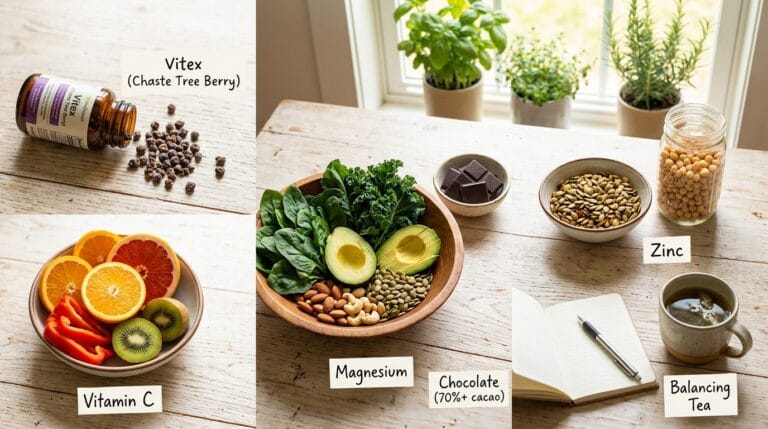
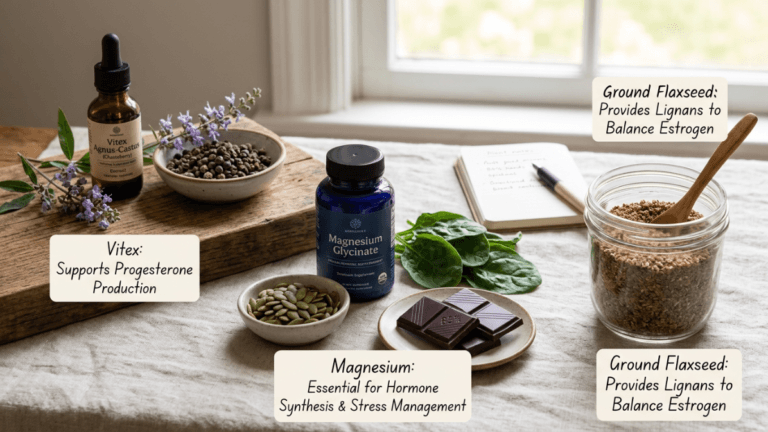
Vitex agnus-castus at 20–40 mg daily, Magnesium glycinate at 250–400 mg daily, and Vitamin B6 at 50–100 mg daily form the strongest evidence-based natural foundation for supporting endogenous progesterone production alongside topical cream application.
These interventions work upstream — targeting the HPG axis signaling and the liver’s estrogen clearance pathways — rather than just adding exogenous hormone. For women using progesterone cream, combining it with these targeted nutrients addresses both the hormone replacement and the root cause of estrogen dominance simultaneously.
Women with low progesterone often experience the same cortisol overload herbs to increase progesterone that further depletes their body’s ability to make its own. Supporting natural synthesis alongside topical application produces faster, more sustainable results than cream alone.
| Intervention | Daily Dose | Mechanism | Time to Results | Key Caution |
|---|---|---|---|---|
| Vitex Agnus-Castus | 20–40 mg | Lowers prolactin via dopaminergic action; stimulates corpus luteum to produce more progesterone | 12–24 weeks | Contraindicated with birth control pills and during pregnancy |
| Magnesium Glycinate | 250–400 mg | Suppresses HPA axis cortisol; enhances liver’s estrogen clearance via COMT enzyme | 2–6 weeks | Citrate form causes GI distress; glycinate is preferred |
| Vitamin B6 | 50–100 mg | Lowers blood estrogen; supports corpus luteum development; resolves aldosterone-driven water retention | 4–8 weeks | Do not exceed 200 mg daily — peripheral neuropathy risk |
| Zinc Picolinate | 30–50 mg | Supports FSH/LH pituitary signaling for ovulation; strengthens corpus luteum progesterone output | 8–12 weeks | Take with food; balance with copper if using long-term |
| DIM | 100–200 mg | Shifts estrogen metabolism in the liver toward safer 2-OH pathways; reduces estrogen dominance load | 4–8 weeks | Urine discoloration is harmless; do not combine with synthetic HRT without medical supervision |
What foods block progesterone cream from working?
Conventionally raised meat and dairy, refined carbohydrates, and alcohol directly worsen estrogen dominance and counteract the effects of progesterone cream: xenoestrogens from animal products overwhelm your estrogen receptors, refined carbohydrates spike insulin and trigger androgen production that blocks ovulation, and alcohol impairs the liver’s ability to clear excess estrogen.
The nutrition piece is non-negotiable. You cannot out-cream a pro-estrogen diet. Dietary fiber is particularly critical — it binds to conjugated estrogen in the gut and ensures excretion. Without adequate fiber, the bacterial enzyme beta-glucuronidase deconjugates estrogen in the intestine and reabsorbs it directly back into your bloodstream, creating a perpetual cycle of estrogen dominance that no amount of topical progesterone will fully overcome.
Practical actionable step: Build every meal around a cruciferous vegetable — broccoli, cauliflower, Brussels sprouts, or kale — which contain indole-3-carbinol that converts to DIM in your stomach and actively reroutes estrogen toward safe clearance pathways.
FAQ
Where is the best place to apply progesterone cream for weight loss?
How long does it take for progesterone cream to work for weight loss?
Do you need to rotate progesterone cream application sites?
What time of day is best to apply progesterone cream?
Should you apply progesterone cream to fatty areas or thin skin?
Can you use a standard blood test to monitor progesterone cream absorption?
Works Cited
- Cleveland Clinic. “Low Progesterone: Causes, Symptoms, Tests & Treatment.” Cleveland Clinic. URL: https://my.clevelandclinic.org/health/diseases/24613-low-progesterone
- NIH / PubMed. “Percutaneous progesterone delivery via cream or gel application in postmenopausal women: a randomized cross-over study of progesterone levels in serum, whole blood, saliva, and capillary blood.” PubMed. URL: https://pubmed.ncbi.nlm.nih.gov/23652031/
- NIH / PMC. “In vitro evaluation of the percutaneous absorption of progesterone.” PMC / NCBI. URL: https://pmc.ncbi.nlm.nih.gov/articles/PMC11139709/
- NIH / PMC. “Progesterone Actions and Resistance in Gynecological Disorders.” PMC / NCBI. URL: https://pmc.ncbi.nlm.nih.gov/articles/PMC8870180/
- NIH / PMC. “Progesterone and Its Metabolites Play a Beneficial Role in Affect Regulation in the Female Brain.” PMC / NCBI. URL: https://pmc.ncbi.nlm.nih.gov/articles/PMC10143192/
- NIH / PubMed. “Dose-dependent efficacy of the Vitex agnus castus extract Ze 440 in patients suffering from premenstrual syndrome.” PubMed. URL: https://pubmed.ncbi.nlm.nih.gov/23022391/
- NIH / PubMed. “Nutritional factors in the etiology of the premenstrual tension syndromes.” PubMed. URL: https://pubmed.ncbi.nlm.nih.gov/6684167/
- NIH / PMC. “Seed Cycling Therapy to Prevent Hormonal Imbalances.” PMC / NCBI. URL: https://pmc.ncbi.nlm.nih.gov/articles/PMC11725979/
- NIH / PubMed. “Cortisol Responsiveness and Predisposition to Obesity.” PubMed. URL: https://pubmed.ncbi.nlm.nih.gov/27345309/
- NIH / PMC. “Progesterone Upregulates Gene Expression in Normal Human Thyroid Follicular Cells.” PMC / NCBI. URL: https://pmc.ncbi.nlm.nih.gov/articles/PMC4454767/
- ACOG. “Compounded Bioidentical Menopausal Hormone Therapy: ACOG Clinical Consensus No. 6.” American College of Obstetricians and Gynecologists. URL: https://www.acog.org/clinical/clinical-guidance/clinical-consensus/articles/2023/11/compounded-bioidentical-menopausal-hormone-therapy
- FDA. “HHS Advances Women’s Health, Removes Misleading FDA Warnings on Hormone Replacement Therapy.” U.S. Food and Drug Administration. URL: https://www.fda.gov/news-events/press-announcements/hhs-advances-womens-health-removes-misleading-fda-warnings-hormone-replacement-therapy
- Endocrine Society. “Compounded Bioidentical Hormone Therapy.” Endocrine Society. URL: https://www.endocrine.org/advocacy/position-statements/compounded-bioidentical-hormone-therapy
- Mayo Clinic. “Hormone therapy: Is it right for you?” Mayo Clinic. URL: https://www.mayoclinic.org/diseases-conditions/menopause/in-depth/hormone-therapy/art-20046372
- NIH / NCBI. “Bioavailability of Compounded Bioidentical Hormone Therapy Preparations.” NCBI. URL: https://www.ncbi.nlm.nih.gov/books/NBK562869/
10 Best Herbs to Increase Progesterone Levels Naturally Without Any Medication